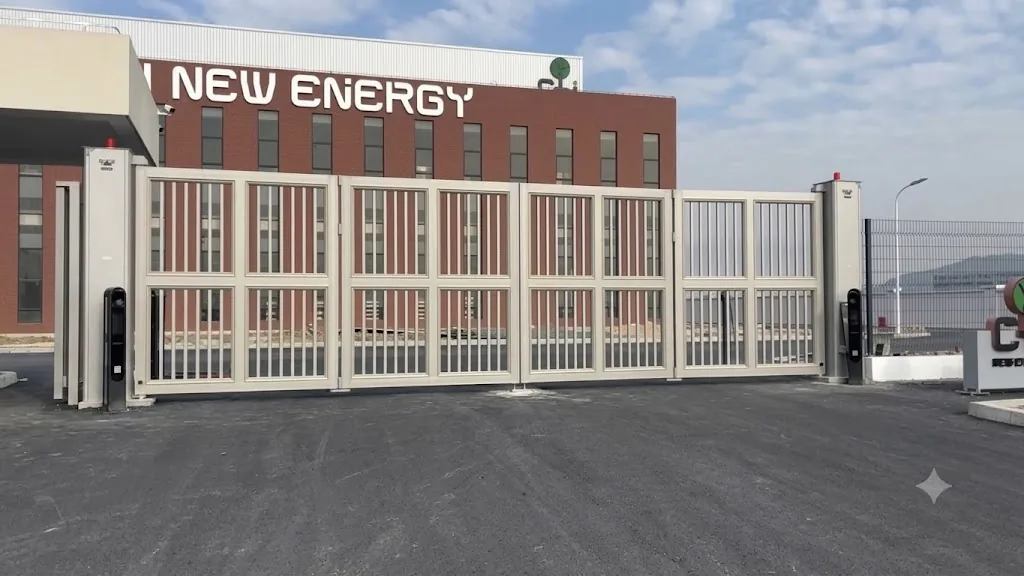
An industrial folding gate earns its keep at one awkward kind of entrance. It's wide enough for trucks, yet boxed in on every side. Maybe there's a guardhouse to the left and a loading ramp to the right, or the yard climbs uphill right behind the line. Swing leaves would sweep into parked trailers. A slider wants a clear run along the fence, and you don't have one. Below, we'll show how we'd put a CAIMEN system together for a site like yours: what carries the load, how it stays safe around forklifts and people, and what we need from you to quote it.
The problem with factory and warehouse entrances
Space kills most gate plans long before strength does.
Say your gate line is six meters from the first dock door. Swing leaves need that whole arc empty. Every opening. Every driver. Has a yard ever kept an arc clear for a full year? Not one we know of. Cantilever sliders get rid of the arc, sure, but they ask for a side run about as long as the opening itself, plus a tail. Got a building, a drain channel or the neighbor's wall over there? Then forget the slider.
So the folding gate sits in between. Its panels fold and stack toward both posts, and you skip both the arc and the long side travel. Our engineering documentation calls it a gate for entrances with limited installation space, which is your brief in a sentence. It also hangs fully suspended. There's no pre-embedded floor track, so puddles, grit and snow sitting in the opening won't jam it.
On a factory apron, honestly, that's the feature I'd pay for. Floor rails there fill up with pallet splinters, gravel and spilled product, and one bent section stops everything.
The recommended CAIMEN combination
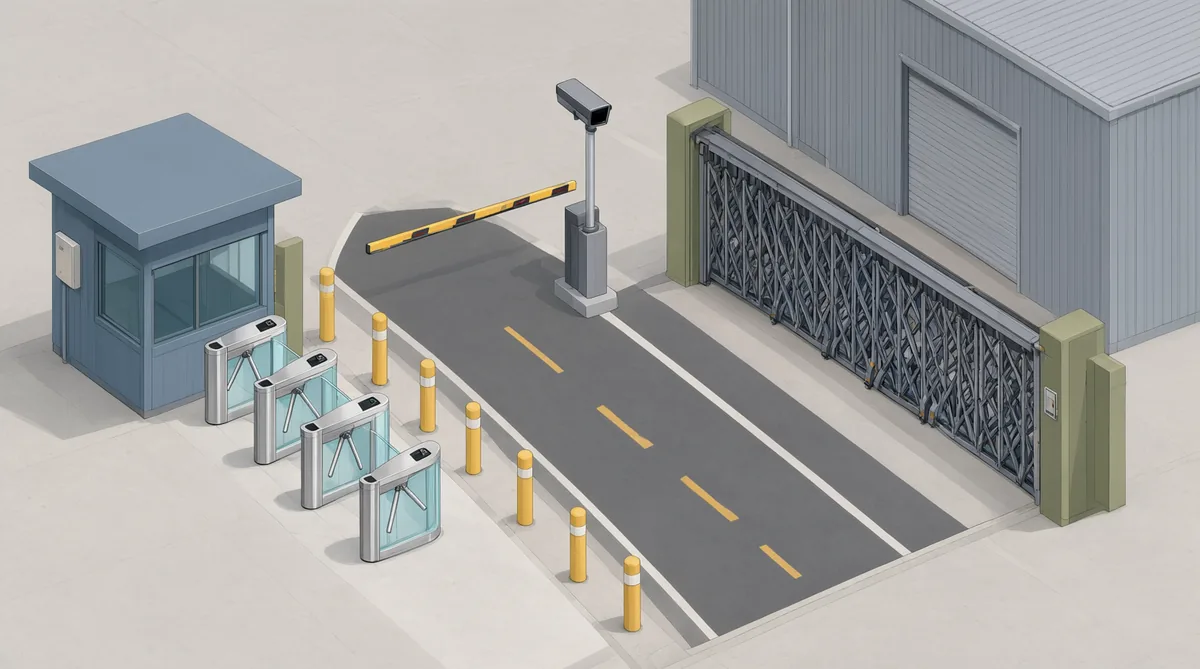
We rarely sell a working entrance just the gate. You'll get better flow from three lanes, each with its own job.
| Component | Job on site | Key points from our documentation |
|---|---|---|
| Automatic folding gate | Physical barrier across the full opening | Patented top-bottom axis, 24 V DC brushless motor (rated 200 W), 6 to 12 s opening, rated for at least 5,000,000 cycles |
| LPR camera with high-speed barrier | Moves staff cars and known trucks at peak times | KS01/KS02 barriers open or close in 1.2 to 2.5 s depending on boom length |
| Pedestrian lane (ST series) | Keeps people off the vehicle apron | Face, fingerprint, QR or RFID; wings swing free on power loss for evacuation |
At shift change, leave the folding gate open and let plate recognition plus the fast barrier work through the car queue. Come nightfall it shuts and acts as the real wall. And walkers? They never set foot in the truck lane. On most sites that one choice does more for safety than anything else on this page.
Gate styles and sizes live on our automatic bifold gates page.
Bearing load and duty: what actually carries the weight
Wide folding gates are heavy. They also hang off posts. If you're the plant engineer, ask one thing first: where does all that weight end up?
Down, in our case. Not sideways. With the patented top-bottom axis, the top pivot guides and the bottom pivot bears the load, so panel weight goes into the ground foundation rather than dangling from side hinges. CAIMEN's engineering data puts a single bearing assembly at 5 to 10 tons of support. The same data says mechanical wear drops by about 60% against a conventional support shaft and service life runs up to three times longer. Those numbers are ours, not an outside lab's. You should know that.
Inside the hinge is a 40 mm reinforced shaft of 304 stainless steel, precision-cast at 1500 °C. A dual-track guide keeps both panel sets folding through 90° together, so one side can't run ahead and rack the frame. Frames use 6005 and 6063 aluminum alloys with AkzoNobel Interpon powder coating, baked twice. (AkzoNobel's weathering tests cover the powder coating itself, not the complete gate.)
Duty next. The 24 V brushless motor carries a rating of 5,000,000 cycles or more. Run it 400 times a day, seven days a week, and you get roughly 34 years of rated motor life on paper. Yours won't last that long. Dust, heat and rough handling see to it. What the math does prove is that the drive isn't your weak link. It's rated for -30 °C to +70 °C, so a frozen loading yard is fine, and so is a desert compound baking at noon. For more on the axis and drive, see our technology page.
Safety on a working apron
Industrial gates get hit. By trucks, by forklifts, by someone wearing headphones.
Infrared anti-collision comes standard on every CAIMEN folding gate. Break the beam and it stops, then reverses. You also get emergency stop, motor thermal protection, soft drive, mechanical self-locking and a manual clutch for power cuts, all as standard. On the electrical side, 10 mA leakage detection kills the supply in under 0.1 s, and cables run through 304 stainless flexible conduit. A diamond-prism warning light is part of the safety package, and a custom voice announcement is an option worth taking where forklifts cross.
Building in the US? Your installer will have UL 325 and ASTM F2200 in mind. In ASTM's summary of F2200, gates fall into four usage classes: Class III covers industrial sites like factories and loading docks, while Class IV is for guarded spots such as airport security areas. The standard names five gate types (slide, swing, vertical lift, vertical pivot and overhead pivot). Bifold isn't on that list. DASMA's UL 325 guidance adds that entrapment protection applies with or without an auto-close timer, and that non-contact sensors go wherever the installer sees an entrapment risk. We don't publish a UL or ASTM listing for this gate. Agree early with your installer and local inspector on how they'll treat it, not on commissioning day.
LPR, RFID and the control side
Everything runs through our 10th Gen smart control system. It takes license plate recognition, face, fingerprint, keypad, mobile app, video intercom, RFID, radar, ground loops and Bluetooth.
So which do you pick? Got mixed visitors and staff? Plate recognition, because nobody has to carry a tag. A fixed fleet of yard trucks is a different story, and RFID wins there since a muddy plate doesn't bother it. Our Red Sea marina project used a folding gate with UHF RFID in the 860 to 960 MHz band, reading at 8 to 10 m in under 10 ms. Not a factory, but the logic carries over. Read early, open early, keep wheels turning.
Put ground loops or radar on the secured side too. Then an exiting truck opens the gate by itself and nobody has to walk over and press a button.
How to plan the site
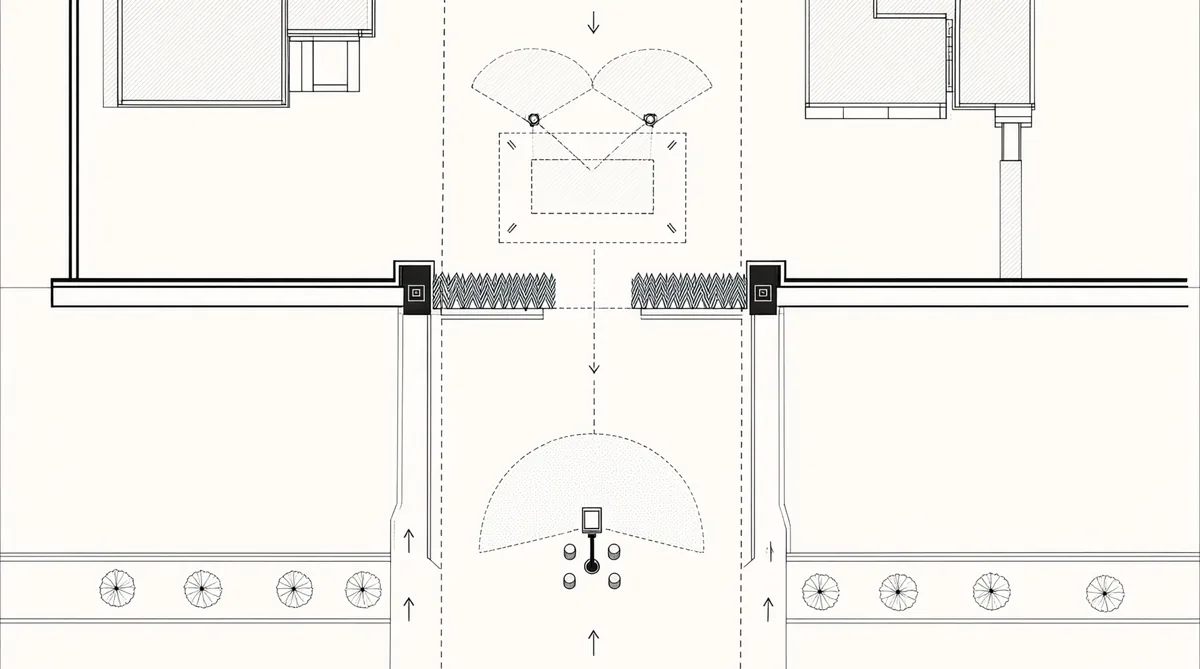
- Measure the clear opening post to post, then check the wall depth on each side where the folded stack will sit. Our guide on measuring for a bifold gate covers the method.
- Check the ground under the posts. The bottom pivot carries the load, so each post foundation is doing the real work. Get a local engineer to size it for your soil.
- Map traffic. Count trucks, cars and walkers at peak hour. Those counts tell you whether you need the barrier and pedestrian lanes or just the gate.
- Plan power and data. Run mains to the drive post, plus a network cable for any LPR camera.
- Decide the access method for each user group before drawings start.
What the crew needs on install day is on our installation page.
What to send us for a quote
- Clear opening width and the gate height you want
- Photos of the entrance from both sides, plus side wall depth
- Rough peak-hour traffic: trucks, cars, pedestrians
- Access methods (LPR, RFID, keypad, app) and any existing system to tie into
- Color (standard is CM-01 gray) and any logo panel
- Climate notes: coastal air, desert heat, hard frost
First you'll get renderings and CAD drawings back from us. Nothing goes into production until you sign off, and production typically takes 15 to 20 days after drawing approval. OEM and ODM work? Welcome. Email [email protected] or use the contact page.
Sources
- ASTM F2200-20 Standard Specification for Automated Vehicular Gate Construction
- DASMA: Gate Operators and UL 325
CAIMEN product figures come from our installation manuals and engineering documentation.