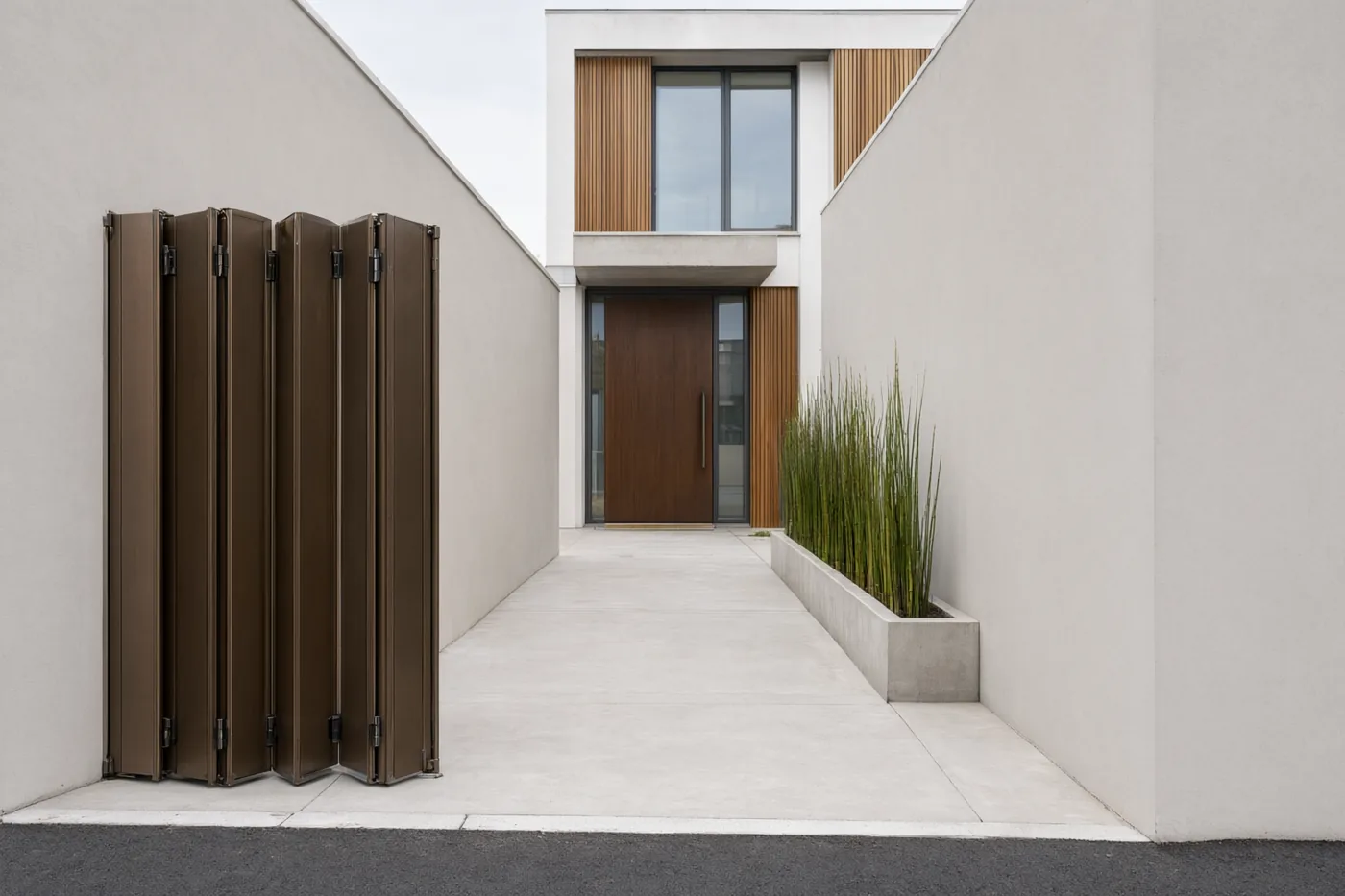
Got a small driveway? Then you already know the squeeze. Your car stops a few feet behind the gate line. The neighbor's fence meets your post with no gap at all, and the street's so close that waiting on a slow gate leaves your bumper in traffic. A folding gate is made for this. Below is how we'd plan one, from the problem to the setup we'd pick, plus the site details (tight entrances, slopes, pavement, a side gate) that decide whether it works on day one or bugs you for years.
Why ordinary gates struggle on a short driveway
Take a swing gate first. Every leaf sweeps a full quarter circle of open ground. Split a 12 ft opening into two 6 ft leaves and you've lost 6 ft of depth: no parking there, no planting, no bins. Most small front yards simply don't have it.
Sliders swap the arc for a long side run. Per the System Equine driveway gate planning guide, you'll want rack space along the fence of roughly 1.5 times the opening width. For a 14 ft opening, that's about 21 ft of straight fence behind the post. Row houses rarely have it. Corner lots almost never do.
Then there's the street. The same guide recommends a generous setback from the road so longer vehicles can clear the street while the gate opens. You can't do that here. So the gate has to open quickly and the same way every time, or the back of your car stays in the lane.
What you need is a gate that clears the full width, asks for very little depth and has no side run at all.
The setup we recommend: a trackless bifold with an in-post motor
A CAIMEN folding gate breaks each side into panels, and as it opens they fold back toward the side walls. Against a swing gate, it shrinks the arc the leaves sweep. Against a slider? The long side-travel run is gone entirely. Everything hangs from a full suspension system, so no track is embedded across your driveway. We'll get to why that matters for pavement.
So what carries the weight? Our patented top-bottom axis. The top pivot guides, while the bottom pivot sends the load straight down into the foundation rather than hanging it off side connection points. CAIMEN's engineering data puts the cut in mechanical wear at about 60% compared with conventional support shafts. Hinge shafts are 40 mm, 304 stainless steel. A dual-track guide keeps both panel sets turning through 90 degrees together, so neither side lags and binds. You'll find the full breakdown on our technology page.
The motor sits inside the cabinet post. It's a 24 V DC brushless unit rated at 200 W, with an operating time of 6 to 12 seconds and a rated service life of at least 5,000,000 cycles. On a tight driveway, that short cycle is the whole point. You won't be parked across the sidewalk for long.
| Gate type | Space it needs on your side | Track in the driveway? | Fit for a small driveway |
|---|---|---|---|
| Double swing | A full arc per leaf, about one leaf width deep | No | Poor if cars park close to the gate |
| Sliding or cantilever | Straight side run of roughly 1.5x the opening | Sliding: yes. Cantilever: no | Poor without a long side fence |
| Trackless bifold (CAIMEN) | Folded panel stack along each side wall | No | Good: small depth, no side run |
Comparing finishes and panel styles? Our bifold driveway gates page shows the residential range, and the trackless folding gate page goes deeper on the suspension system.
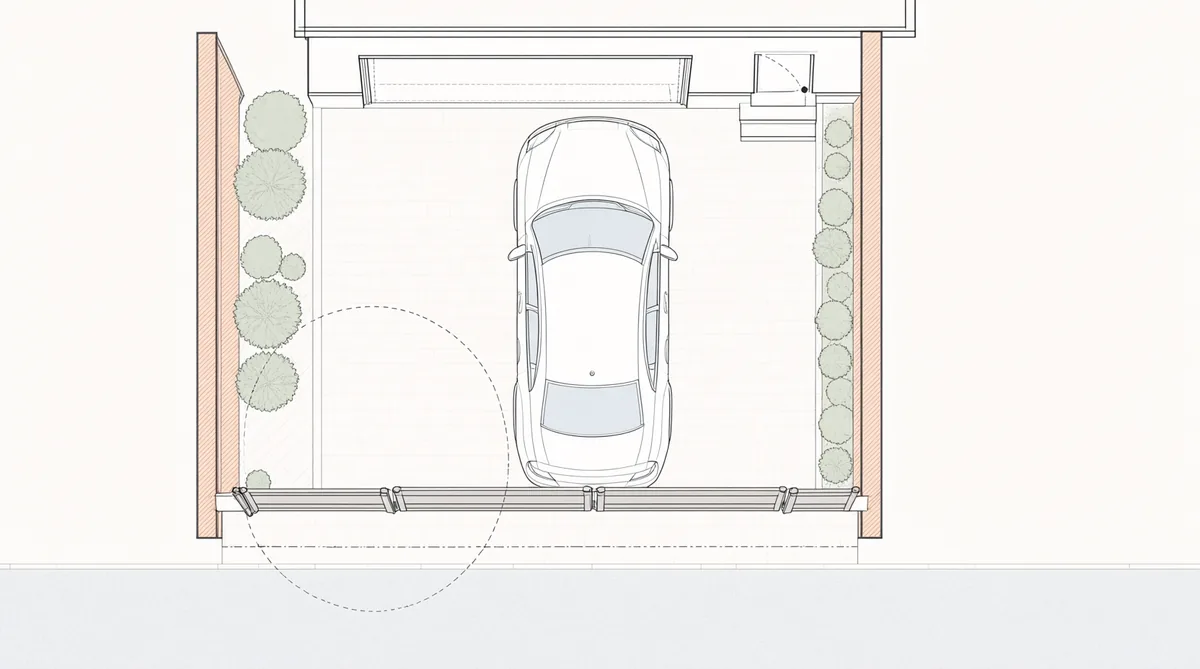
Measuring a tight entrance
Guessed numbers cause most bad quotes. Grab a tape measure. It'll cover everything we need.
- Clear opening: measure between the inside faces of the posts or pillars at the top, the middle and the bottom, then use the smallest reading.
- Wall length each side: how far the wall or fence runs straight in from each post before it turns, steps or ends.
- Clear depth each side: from the gate line to whatever a folded panel could hit first, like a downpipe, a meter box or a parked car's mirror.
- Height: the gate height you'd like, and anything overhead such as a porch beam or a low tree limb.
Skip the folded stack depth. It depends on panel count and panel width, and that's exactly what our CAD drawing works out. Your job is just to tell us what space is there. If you'd like a checklist to paste into an email, see our guide on how to measure a driveway for a bifold gate.
And take photos. They help more than people think, so get one from inside looking out and one from the street looking in.
Slopes and crossfall
Here's where small driveways get awkward. Plenty climb up from the street. Others tilt sideways toward a drain.
Any gate that swings cares about grade. A swing gate, says the System Equine guide, needs ground that's relatively level across its whole arc, and the DASMA article on designing access points with obstacles makes a related point for hillside sites: a road grade can only be flattened so far. Because a folding gate sweeps a much shorter arc than a full swing leaf, you're already ahead. Slope doesn't vanish, though. The panels still turn over the ground right behind the gate line.
Measure it. Stretch a string level from the bottom of one post across to the other and write down the drop, then repeat inward along each fold side for roughly the depth you measured earlier. Say your driveway rises 3 inches over the first 5 ft behind the gate. That figure goes on the drawing, and we set the panel bottom clearance around it.
Our honest take? If the slope is steep right at the gate line, regrading a short pad is often cheaper than fighting it with the gate.
Pavement, drains and what goes in the ground
With the gate fully suspended, nothing crosses your driveway surface. You won't cut a track into stamped concrete, and there's no channel to clog with grit, leaves or ice. Rain, snow and standing water don't affect how the panels move. That's a real relief at the low end of a sloped drive, where water likes to sit.
The ground still has a job. Since the bottom pivot drives the gate's weight straight down, each cabinet post needs a solid concrete footing built to the installation drawing CAIMEN supplies. Pavers laid on sand won't carry that alone. Your installer will advise how to work the footings into your pavers.
Tell us early about:
- Drains, gullies or channels near the posts
- Buried pipes or cables along the wall line
- The surface type: poured concrete, asphalt, pavers or gravel
- Where the nearest power supply is, since the motor needs a cable run to the post
Power and safety come built in. A 304 stainless flexible conduit carries the cable, and 10 mA leakage detection cuts power in under 0.1 seconds. Break the infrared beam and the gate stops, then reverses. Power cut? A manual clutch lets you open it by hand.
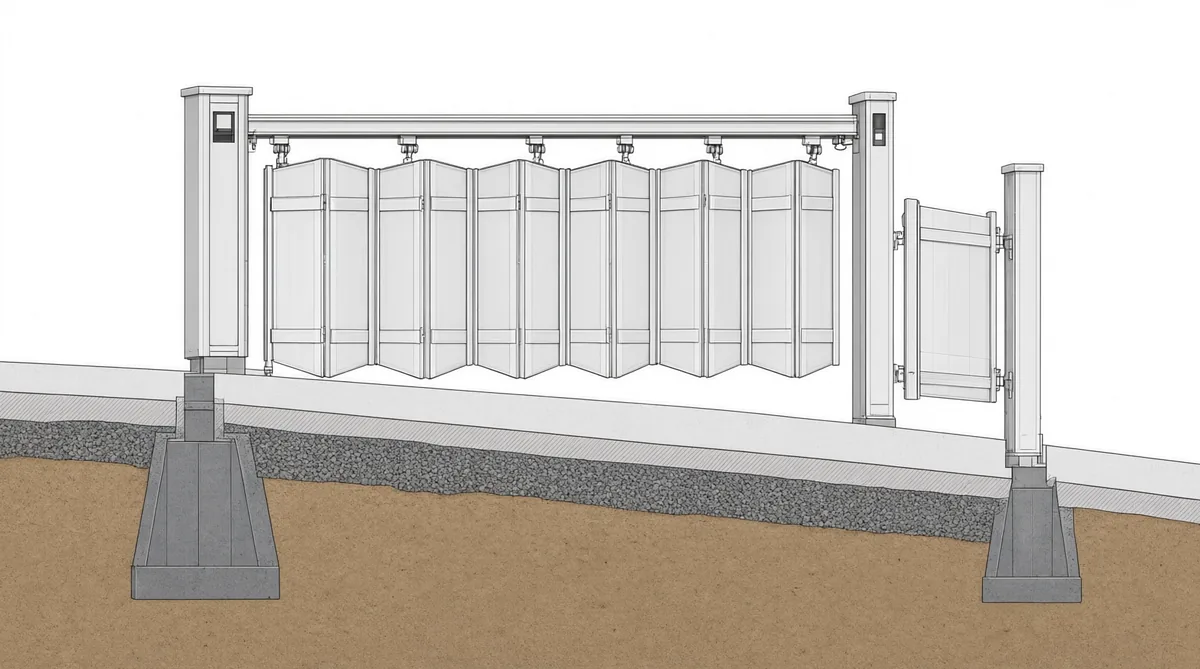
Adding a side gate for people
On a small lot, opening the whole driveway gate for a mail carrier or a kid on a bike gets old fast. A separate pedestrian gate fixes that. The System Equine guide gives 4 to 6 ft as a typical pedestrian gate width, though on a narrow frontage you may choose a slimmer gate.
CAIMEN also makes an aluminum villa side gate, with finish options that can be chosen to match the main gate. We confirm profile and finish on the drawing. On the folding gate itself, our standard finish is AkzoNobel Interpon powder coating, applied with a double bake. Draw the side gate into the same plan as the main gate, not later. It moves the posts, and it changes how much wall is left for the folded panels.
Access control can link the two. The folding gate's 10th Gen control system connects to keypads, RFID, a mobile app, video intercom, LPR and other inputs. Add a card reader or remote on the side gate and most households are covered, though you should confirm side-gate access options on the quote.
What to send for a quote
Email [email protected] or use the contact page, and include:
- Clear opening width (smallest of three readings) and desired height
- Wall length and clear depth on each side
- Slope across the opening and along each fold side
- Surface type, drains and power location
- Whether you want a side gate, and how wide
- Access control preferences, plus a photo or two from each direction
Renderings and CAD drawings come first. Nothing goes into production until you approve them, and production typically takes 15 to 20 days from that approval.
Sources
- The Complete Driveway Gate Planning Guide (System Equine)
- Designing Access Points with Obstacles in Mind (DASMA, Door and Access Systems, Fall 2022)
CAIMEN product figures come from our installation manuals and engineering documentation.