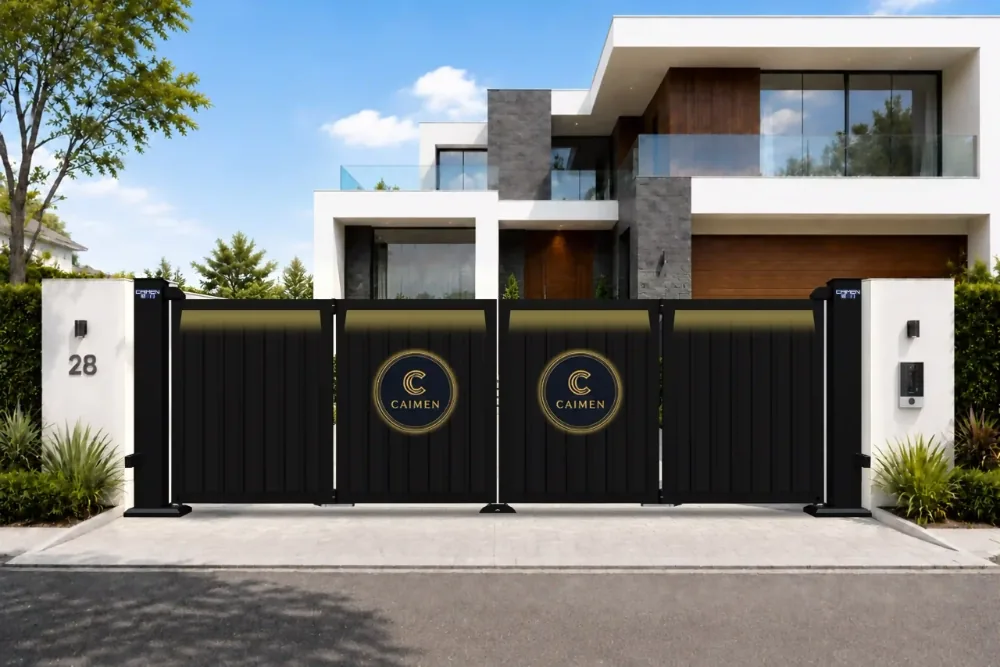
Bifold driveway gates fix one stubborn villa problem. Your entrance fits two cars side by side. Fine. But the house sits close behind it, or a garden wall does, or the ground climbs, so a swing gate has nowhere to go. And there's no spare stretch of fence for a sliding leaf to roll along either. A bifold gate gets around that by folding its panels compactly against each post, so you lose the swing arc altogether. Below you'll find the CAIMEN parts we'd put together for a home or villa, how to plan the site, and what we need from you before we can draw it.
Why a folding gate suits a short driveway
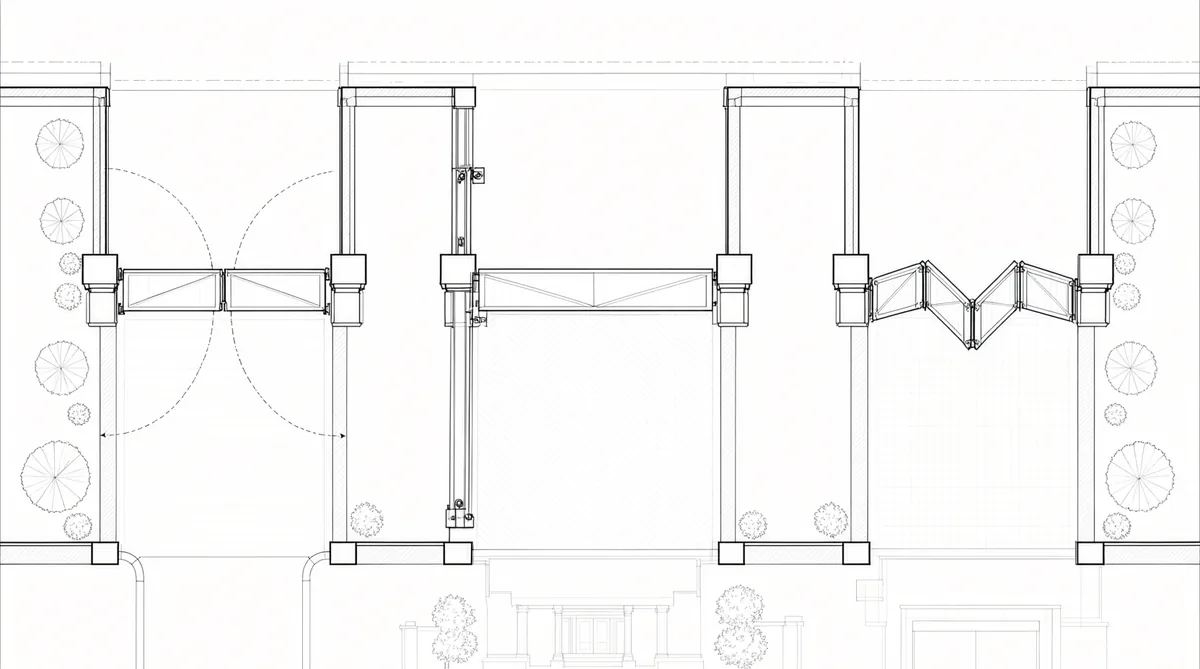
Think about what a swing gate asks of your plot. Each leaf needs open ground behind it as deep as the leaf is wide. Split a 5 m opening into two leaves and you've got 2.5 m of swing per side, with nothing parked, planted or sloped in the way. Sliding gates skip the arc. They need a run of wall or fence at least as long as the opening instead, and lots of villa plots simply don't have one.
Our engineering documentation describes the bifold gate as made for entrances with limited installation space. Its panels fold and retract toward both sides, so there's no swing arc and no long side-travel track. It's fully suspended, too. No pre-embedded tracks go into the driveway, which means rain, snow and standing water don't affect it. Your paving stays one clean surface.
People underrate that last bit.
A track cut across the drive is exactly where grit piles up, where frost cracks the concrete, and where somebody's heel gets caught on the way to a dinner party.
What about width? The Concrete Network's driveway design guide puts a single-car drive at 10 ft minimum (12 ft preferred) and a double drive at 20 ft minimum (24 ft preferred). Size your gate to the drive you really use, not to the tightest gap between the pillars. Still measuring? Our guide on how to measure a driveway for a bifold gate has the details.
The recommended CAIMEN combination
For most homes we pair the bifold leaves with posts that carry the drive, a 24 V control system, and whatever safety and access add-ons a family driveway needs. The table shows how it fits together.
| Part | What CAIMEN supplies | Why it matters at home |
|---|---|---|
| Leaves and frame | 6005 and 6063 aluminum alloys, AkzoNobel Interpon outdoor powder coating, standard color CM-01 gray (customizable) | No rust bleeding onto pale stone pillars; color can match windows or railings |
| Support | Patented top-bottom axis: top guidance, bottom load-bearing pivot | Leaf weight goes into the foundation, not into hinges hanging off the post |
| Hinge | 40 mm, 304 stainless steel shaft, precision-cast at 1500 °C | Quiet folding near bedrooms and terraces |
| Drive | 24 V DC brushless motor, rated 200 W, 6 to 12 s operating time | Low-voltage, quick enough that you're not waiting on the street |
| Control | 10th Gen smart control system | Links to remotes, keypad, app, intercom or plate recognition |
| Safety | Infrared anti-collision, 10 mA leakage detection, manual clutch, self-locking | Children, pets and visitors around a moving gate |
According to CAIMEN, the top-bottom axis cuts mechanical wear by approximately 60% compared with a conventional support shaft and extends service life up to 3 times. Those are our own engineering figures. Nobody independent tested them. Still, the idea is easy to follow: a leaf resting on a bottom pivot won't sag the way one hung from side hinges can. You'll find the whole mechanism on the bi-folding gate system page.
Choosing a model and a design
Villa projects usually begin with the CMZD series. Treat these models as a starting point; our CAD team can adapt size, infill and color to your entrance on the drawing before anything is made.
| Model | Gate leaf height | Post height |
|---|---|---|
| CMZD-1811 | 2.0 m | 2.08 m |
| CMZD-1812 | 2.0 m | 2.08 m |
| CMZD-1806 | 2.0 m | 2.3 m |
| CMZD-1902 | 2.0 m | 2.3 m |
| CMZD-2001 | 2.0 m | 2.3 m |
| CMZD-2102 | 2.0 m | 2.3 m |
So which one? Look at the posts first. With 2.08 m posts the top sits nearly flush with the leaf, and the whole thing reads lighter and more modern. The 2.3 m posts rise above the gate. That gives a stronger, more formal entrance, and it tends to look right next to stone pillars or a long boundary wall.
Infill comes next. Vertical bars keep your view of the street and let wind pass through. If you want privacy for a front garden or a pool, go denser. Got a classic-style house? Decorative cast aluminum parts are available. You can browse renderings on our bifold gate designs page. Already have a sketch, or a photo of a gate you like? Send it, and our CAD team will draw it to scale before anything gets cut.
Here's our honest take. Settle post height and infill first and leave color for last, because color is easy to change on a drawing and a post that's too short for your pillars isn't.
How you'll open it every day
You'd be surprised how many people use a home gate. There's you and your family, then a cleaner, a delivery driver, eight guests on a Saturday night. The 10th Gen control system is built for that mix. Our engineering documentation lists license plate recognition, face recognition, fingerprint, keypad, a mobile app, video intercom, RFID, radar, ground loop and Bluetooth as options it can connect to. A radio remote comes standard.
- Family cars: remotes or plate recognition, so the gate starts opening as you turn in.
- Staff and regular visitors: a keypad code or RFID card you can cancel when they leave.
- Deliveries and guests: a video intercom, opened from your phone or a panel in the house.
- Exit: a ground loop or radar, so nobody leaving needs a remote at all.
It opens in 6 to 12 s. In practice, that's usually before your car has finished turning off the road. Want more on the motor? Our post on the automatic bifold gate motor covers the 24 V brushless drive, rated at 5,000,000 cycles or more and working from -30 °C to +70 °C.
Safety on a family driveway
Kids ride bikes on driveways. Dogs bolt after cars. You can't treat safety as a checkbox here.
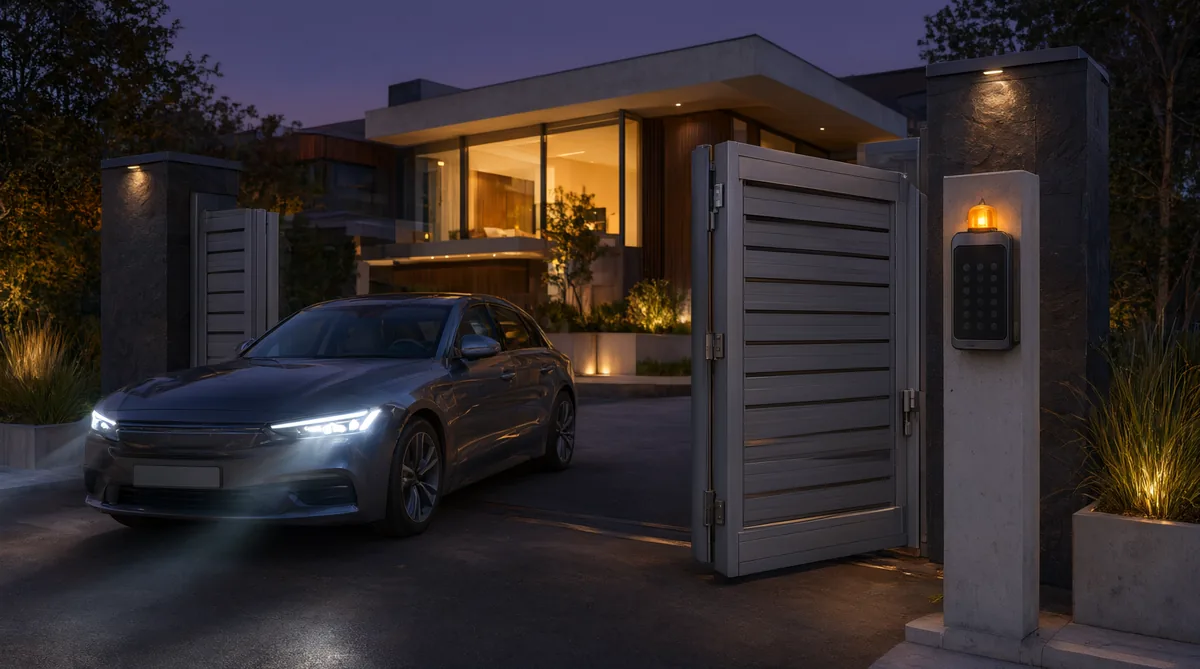
Infrared anti-collision is standard, so if anything breaks the beam, the gate stops and reverses. You also get motor thermal protection, soft drive, a manual clutch and an emergency stop as standard. Leakage detection works at 10 mA and cuts the power automatically in under 0.1 s, while the cables run inside a 304 stainless steel flexible conduit. There's an optional diamond-prism warning light with a customized voice announcement. Does your gate open onto a footpath? Then add it.
In the US, gate operators are generally expected to follow UL 325. DoorKing's summary of the standard says it calls for at least two entrapment protection devices for each entrapment zone in each direction of travel, usually the operator's built-in system plus external sensors like photo eyes or edges. ASTM F2200 covers how the gate itself is built. Check with your local installer about which devices your jurisdiction expects, and we'll specify the drawings to match.
Planning the site, step by step
- Measure the clear opening between finished pillars, plus the depth you'll have on each side once the leaves fold.
- Check the ground under each post. Leaf weight sits on the bottom pivot, so the base has to be solid and level; your installer sizes it to local soil.
- Plan power and cable routes before paving. Lay a conduit under the drive now and you won't be cutting new stone later.
- Decide where controls go: keypad at car-window height, intercom by the pedestrian approach, loop or radar on the inside.
- Think about the coast. If you can see the sea from the plot, read our notes on folding gates for coastal properties before you pick finish and hardware.
Say your opening is 4.5 m, the garage is 4 m behind it, and the plot slopes gently down toward the road. A swing gate would scrape that slope and block the garage apron. Fold a bifold pair against each post instead and there's no track to cut across the drive. The folding leaves still sweep a small arc, though, so we check slope clearance on the CAD drawing before anyone signs off. That's the sort of site where this gate earns its keep. Working with something even tighter? See folding gates for small driveways.
What to send for a quote
We don't publish prices. Every villa entrance gets drawn to its own size, so a price list wouldn't mean much. For drawings and a quotation, send us:
- Clear opening width and preferred gate height
- Photos of the entrance from the street and from inside
- Which model or design you like, or a sketch
- Color (RAL code or a photo of the window frames you want to match)
- How you want to open it: remote, keypad, app, intercom, plate recognition
- Power available at the gate and the site's location (coastal or inland)
CAD drawings and renderings come first. Production doesn't start until you approve them, and it typically takes 15 to 20 days after drawing approval. On the 24 V control system you get 7-day replacement and a 1-year warranty for quality issues. Write to [email protected] or use the contact page. We'll send back a drawing you can hold up against your own driveway.
Sources
CAIMEN product figures come from our installation manuals and engineering documentation.